How to Improve CSAT Score using AI: 7 Practical Tips That Work

One bad customer experience can undo a hundred good ones.
That’s how businesses operate in 2026.
Customers have more choices, higher expectations, and very little patience for experiences that don’t meet their needs. If you fail to leave a strong impression, customers will quickly turn to competitors.
This is where CSAT, or Customer Satisfaction Score, plays a critical role in determining the health and success of your business.
But improving CSAT isn’t as simple as asking for feedback and making small tweaks anymore.
The real shift is happening with AI.
AI is changing how businesses understand, respond to, and even anticipate customer needs. It helps teams move faster, personalize interactions, and solve problems before they escalate.
In this blog, we’ll break down what CSAT really means, how to measure it, and most importantly, how you can use AI to improve it in practical, proven ways.
Key Takeaways
- AI tools like sentiment analysis, chatbots, and predictive analytics to understand customer needs in real time and resolve issues faster while keeping up with the CSAT score of customers.
- Delivering consistent and always-on support with AI to reduce friction while making every interaction more relevant and personalized.
- It helps in turning customer data into actionable insights to continuously improve service quality and drive higher CSAT scores.
What Is a CSAT Score in Customer Service?
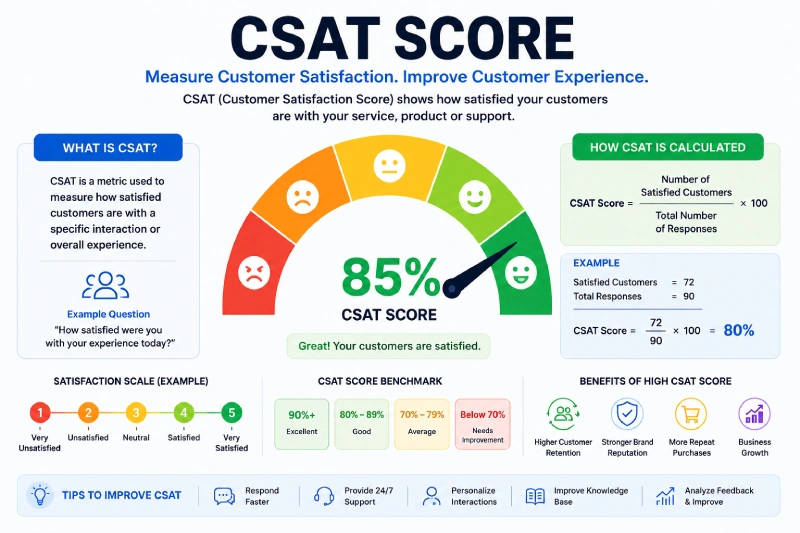
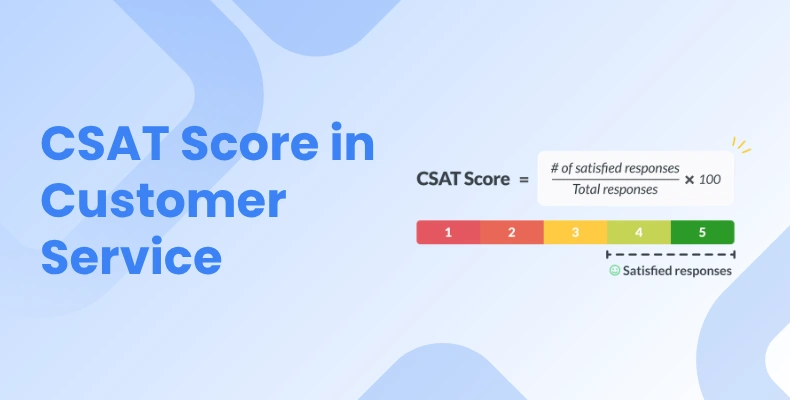
CSAT, or a customer satisfaction score, is a simple metric that shows how satisfied your customers are with your brand, service, or interaction.
It is measured by asking directly, “How satisfied were you with your experience with us?” and customers respond with a rating. The CSAT score is calculated and scaled from 1 to 5 or 1 to 10, with higher numbers indicating higher satisfaction.
In short, CSAT shows how well you met customer expectations at that moment.
Let’s say you contacted a food delivery app because your food order was delayed. The customer service solves your problem and quickly responds. Once the chat ends, you are asked to rate your experience and select the ratings from 1 to 5 based on your experience.
It’s quick, direct, and one of the clearest ways to understand how customers feel right after an interaction.
How to Measure CSAT Score?
Measuring CSAT is a very straightforward process. You can measure it by asking customers a simple question after an interaction, then turning their responses into a percentage.
The most common question asks customers how satisfied they were with the service or experience.
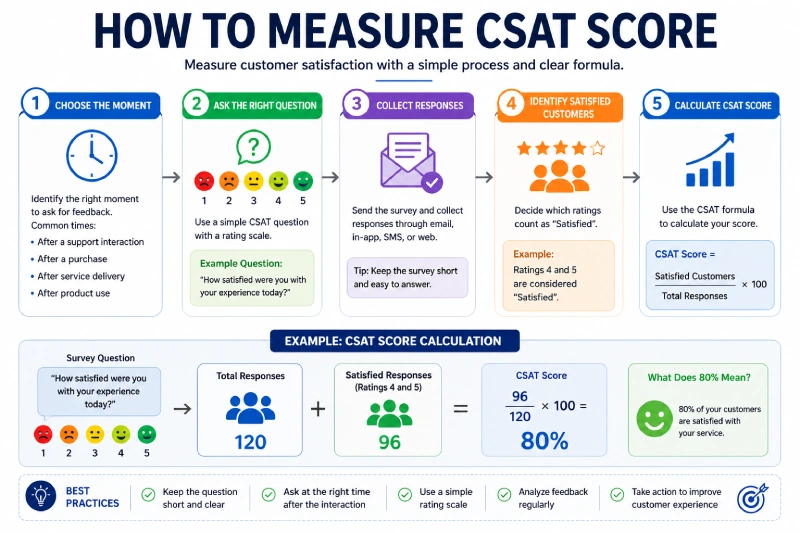
Customers usually answer by rating their experience
- 1 to 5 (From very unsatisfied to very satisfied)
- 1 to 10 (Low to high satisfaction)
You only count the positive responses, typically the top ratings (like 4 and 5 on a 5-point scale).
Here’s the formula:
CSAT % = (Number of positive responses ÷ Total responses) × 100
Let’s say 100 customers responded to your survey:
- 70 gave a rating of 4 or 5 (Satisfied)
- 30 gave lower ratings
Your CSAT score would be 70%.
When to measure CSAT
CSAT works best when measured right after key interactions, such as:
- After a customer support chat or call
- After a product purchase or delivery
- After resolving a complaint
This way, the feedback is fresh and reflects the real experience, not a delayed opinion.
Growth of AI in Customer Experience
Customer experience has changed in the past few years, with AI playing a major role.
Support teams were used to manually react to each one of the customers, which was time-consuming, and sometimes customers needed to wait for longer times to even get simple answers.
Earlier, support teams were mostly reactive. Customers reached out, agents responded, and that was it. Today, AI allows businesses to be faster, smarter, and even more proactive in how they handle customer needs.
AI is now being used across the entire customer journey. Chatbots handle common queries instantly. Voice agents manage high call volumes without long wait times. Machine learning models analyze past interactions to predict what a customer might need next. This shift is helping companies move from basic support to more personalized and efficient experiences.
One of the major reasons for the growth is scale. As businesses scale and grow, customer queries increase, and then hiring and training the customer support team takes up a lot of time and financial resources.
Whereas AI just needs to be trained once, it can manage tons of queries in a day, 24/7, and also help with repetitive tasks. In this situation:
- Requires fewer human agents
- Reduces ongoing human resource costs
- Reduces time spent training support and staff
- Quick turnarounds and easily identify patterns
- AI will make faster decisions and provide better service quality
Customers have also changed.
They expect quick responses, 24/7 availability, and consistent experiences across channels. AI makes this possible without overwhelming support teams.
In simple terms, AI is not just improving customer service. It is reshaping how businesses understand and serve their customers, making experiences more responsive, more personal, and more efficient.
7 Effective Tips to Improve CSAT with AI
Improving CSAT is not a one-night task. It’s the process, a process that grows with customer trust.
It’s about consistently getting the small moments right across every customer interaction. AI helps you do that at scale, without losing quality.
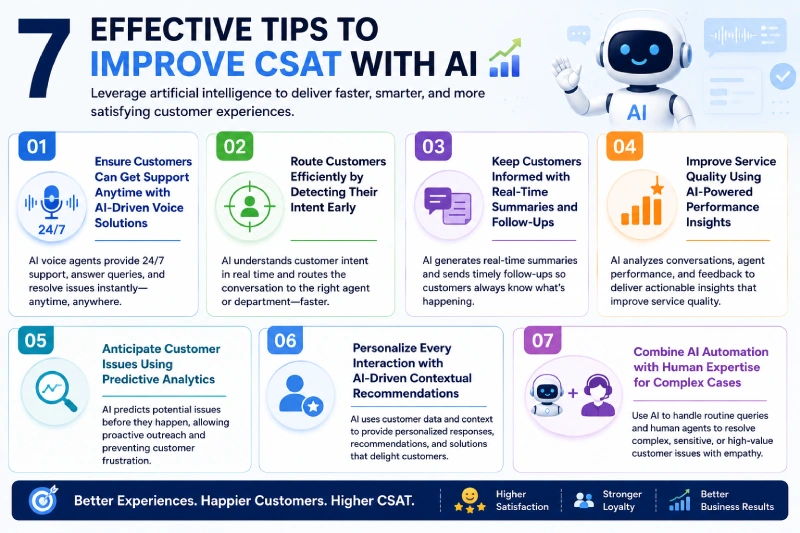
Here’s how you can use it in practical ways:
Ensure Customers Can Get Support Anytime with AI-Driven Voice Solutions
We all know customers come anytime, even for simple or common queries. They expect help when they need it, no matter what time it is.
AI-powered voice solutions let you offer 24/7 support without increasing team size. These systems can handle common queries, guide users through simple processes, and reduce wait times significantly.
The real benefit is not just availability, but consistency. Customers get quick responses at any time, which directly improves satisfaction.
Route Customers Efficiently by Detecting Their Intent Early
Nothing feels more frustrating than getting transferred multiple times in a customer care call. Even for simple or common queries, what the customer is saying, whether it is a common query or one that needs human assistance. If there is human intervention required, it will not let customers wait, but will immediately do a human handoff.
This will reduce resolution time, avoid repetition, and make the experience smooth right from the beginning.
Keep Customers Informed with Real-Time Summaries and Follow-Ups
Customers like to stay informed and want to know the status of where their queries have reached and what’s going on with them. AI can generate real-time summaries during interaction and can update them in real time.
This will help keep the customers on the same page, increase trust level, and also make contacting and asking about their status easier. When customers feel informed, they feel more in control, and that builds trust.
Improve Service Quality Using AI-Powered Performance Insights
Let your authoritative team players not work under the guess games. AI helps in analyzing the patterns by observing and studying thousands of conversations and highlighting patterns that need to be corrected.
Instead of guessing, managers will have clear insight into what is working and what’s not. This helps teams train better, fix weak points, and deliver more consistent service.
Anticipate Customer Issues Using Predictive Analytics
The best support experience is the one customers don’t need to ask for. AI can predict potential issues based on past behavior, product usage, and emerging trends. It easily detects the problem and provides proactive support and guidance.
Solving problems before they happen creates a strong positive impression and boosts CSAT significantly.
Personalize Every Interaction with AI-Driven Contextual Recommendations
AI helps in providing highly personalized support and experience to customers in real time. It does not need repeated queries to solve problems; it will analyze everything from past interactions, purchase history, preferences, and behavioral patterns to understand each customer’s context instantly.
This allows businesses to tailor responses, recommendations, and solutions to the individual. Instead of giving standard answers, AI can suggest actions that match what that specific customer needs at that moment.
During conversations, AI can also adapt on the fly. It detects intent and surfaces relevant content, product suggestions, or next steps based on what the customer is asking. This keeps interactions focused and meaningful.
Combine AI Automation with Human Expertise for Complex Cases
AI is powerful, but it’s not meant to replace human judgment.
For complex or sensitive issues, customers still prefer human interaction. AI handles repetitive tasks and provides agents with relevant information, allowing humans to focus on empathy and complex problem-solving.
This balance ensures efficiency without losing the personal touch that drives true customer satisfaction.
Improving CSAT today is not just about responding faster. It is about understanding customers better, solving their problems sooner, and making every interaction feel smooth and relevant.
Conclusion
AI works based on how it is trained, which makes it a powerful tool for improving CSAT, especially when handling high volumes of queries and responding to repetitive customer questions on time.
The real impact of AI comes when it is combined with human expertise, where both work together to improve customer satisfaction and build long-term loyalty.
Improving CSAT becomes easier with the right system in place, and that’s where Rossy AI helps by automating support, managing customer calls, and improving service efficiency without increasing the workload on support teams.
If you’re looking to improve your CSAT with AI, the next step is to see how it works in practice. Book a demo to explore how you can automate support, manage customer interactions more efficiently, and deliver better experiences without increasing your team’s workload.
Frequently Asked Questions
What is considered a good CSAT score?
A good CSAT score typically ranges between 70% and 85%, depending on the industry. Anything above that is considered excellent, but the benchmark can vary based on customer expectations and service type.
How quickly should you collect CSAT feedback after an interaction?
It’s best to collect CSAT feedback immediately after the interaction ends. This ensures the experience is still fresh in the customer’s mind, leading to more accurate responses.
Can AI replace human customer support completely?
No, AI is best used to support human agents, not replace them. It handles repetitive tasks and speeds up processes, while humans manage complex and emotionally sensitive situations.
How does AI help reduce response and resolution time?
AI can quickly understand customer queries, provide quick answers, and route issues to the right agent. This reduces waiting time and eliminates unnecessary back-and-forth.
What are the biggest challenges when implementing AI in customer support?
Some common challenges include poor data quality, lack of proper training for AI systems, and over-reliance on automation without human backup. A balanced approach works best.
See More Blogs
7 Proven Call Reduction Strategies to Boost Customer Support Efficiency
Every customer support interaction tells a different story. Sometimes, it is a simple call that should not have needed a…
Read More
How AI Voice Agents Reduce SaaS Customer Support Costs
When customer support starts consuming a significant portion of your SaaS budget, it quickly becomes a significant operational challenge. Support…
Read More